
Many cross-border sellers and factories care about the same three things when choosing a Southeast Asia sea freight DDP line: stable transit time, fewer unexpected delays, and no hidden charges.
Southeast Asia sea freight DDP delays usually come from five areas: cargo acceptance, export declaration, vessel space, destination customs clearance, and warehouse or trucking operations. A reliable DDP line controls the full door-to-door process instead of only focusing on the sailing time.
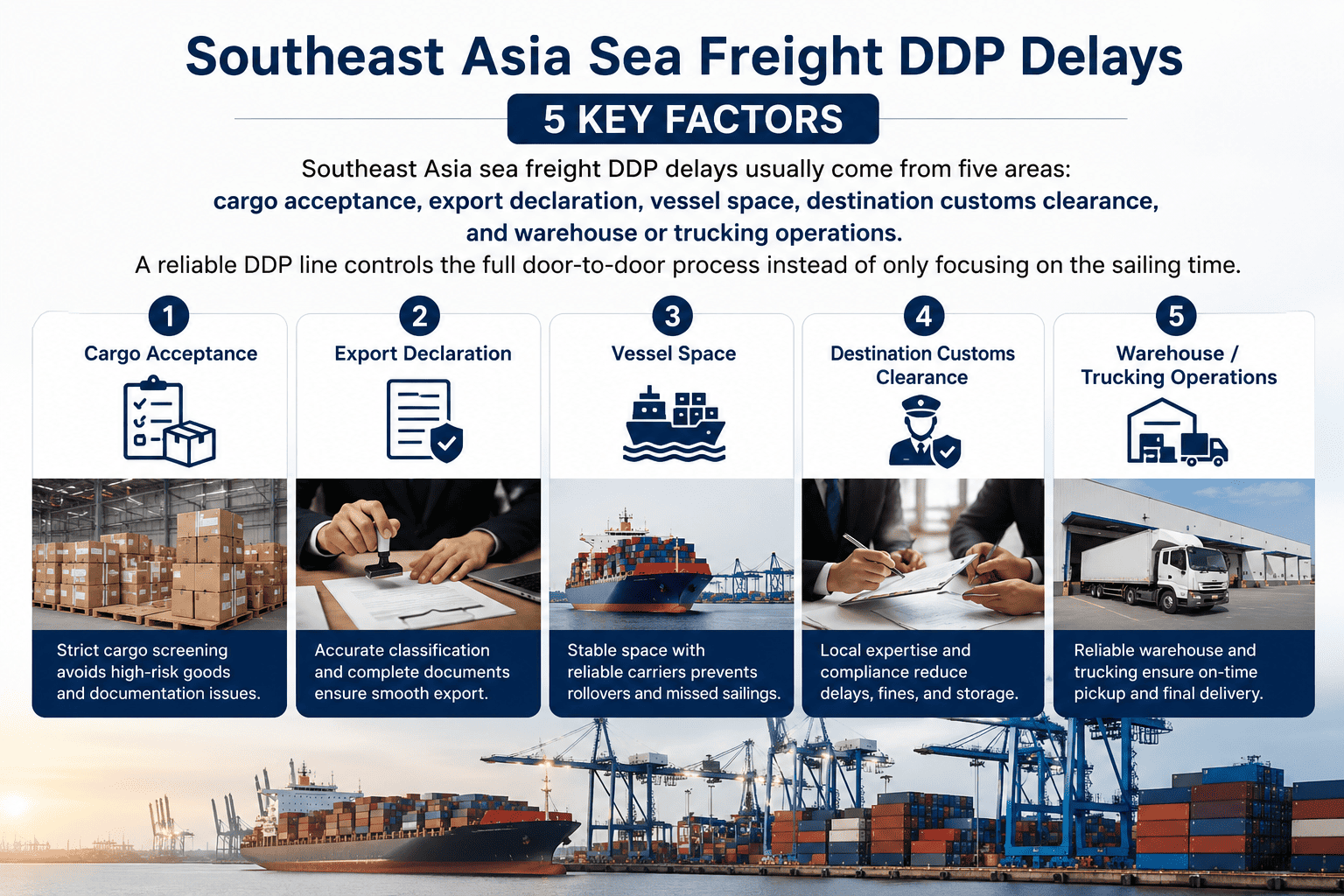
I have worked with China-to-Southeast-Asia DDP shipments for years. I have seen two shipments going to the same country perform very differently. One shipment may arrive smoothly. Another shipment may lose one or two weeks because of customs inspection, vessel changes, warehouse problems, or poor cargo screening. This is why I never judge a shipping line only by the advertised transit time.
Why Is Cargo Acceptance the First Hidden Risk in Southeast Asia DDP Shipping?
Many [freight forwarders][1] want more cargo volume, so they accept almost every product. This looks convenient to customers, but it can create serious risks for consolidated sea freight.
For LCL and consolidated DDP shipments, one high-risk shipment can affect the whole container. A reliable freight forwarder checks product name, material, packaging, documents, and compliance requirements before loading cargo into the same container.
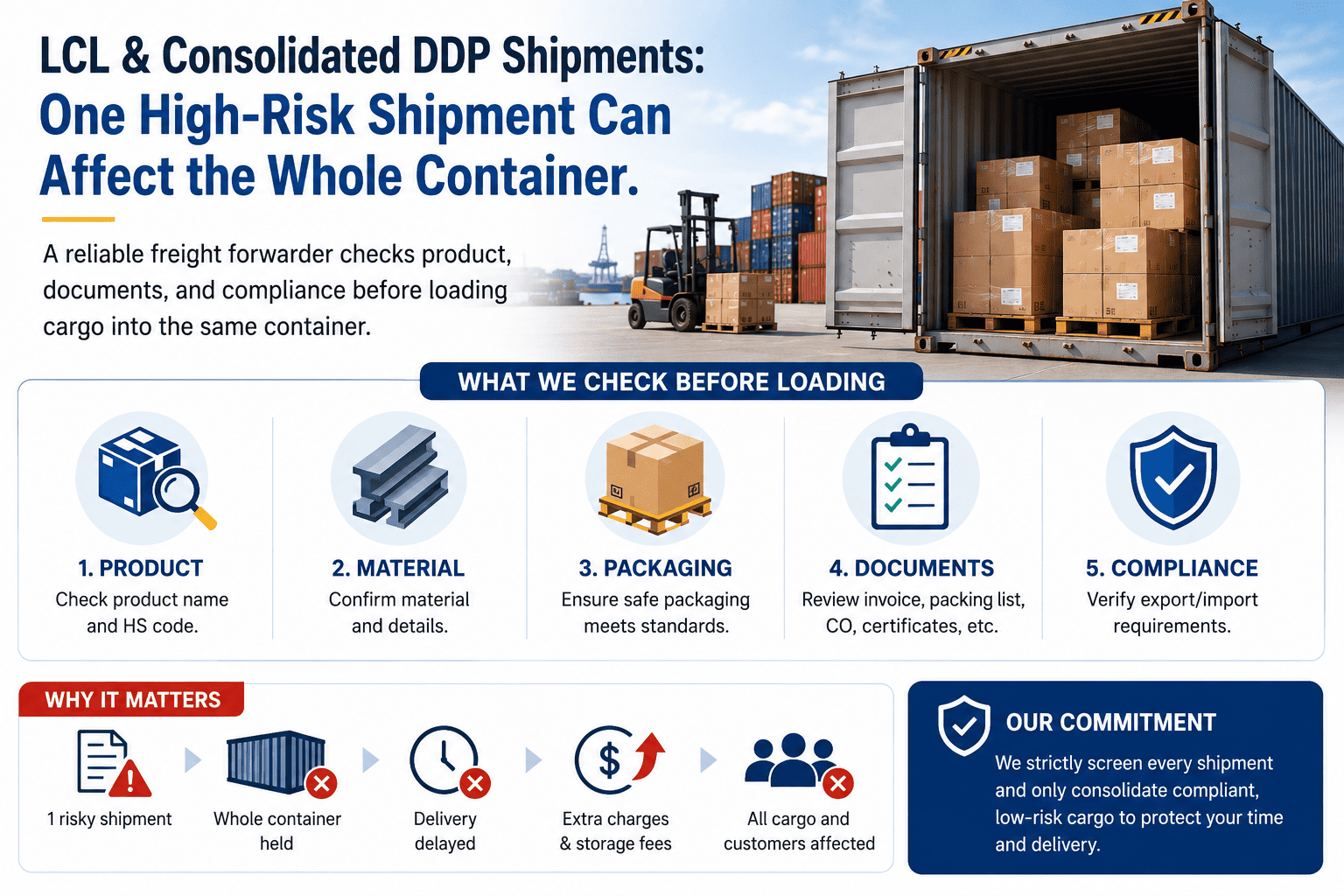
One Risky Shipment Can Delay Everyone in the Container
This is one of the most important lessons I have learned from sea freight operations.
[A consolidated container][2] is not just a group of unrelated cartons. In practice, the cargo shares the same physical container and often moves through several customs and terminal steps together.
If one shipment creates a serious customs problem, the inspection can affect the whole container.
This is why I do not think “we can ship almost anything” is always a good selling point.
Sometimes it is a warning sign.
A freight forwarder may attract customers by accepting sensitive cargo with very few questions. The shipping price may also look cheaper at the beginning.
But the real cost appears later.
The container may be held.
Documents may need to be corrected.
Cargo may need to be separated.
Storage charges may start.
The vessel schedule may be missed.
Every other customer in the same container may then experience the same delay.
Which Types of Cargo Need More Attention?
In my daily work, I pay extra attention to products with special export, packaging, safety, or destination-import requirements.
Examples may include:
| Cargo Type | Possible Risk | What I Check Before Shipping |
|---|---|---|
| Metal products | Export control or classification issues | Material, use, HS code, export documents |
| Wood packaging | Fumigation or quarantine requirements | Packaging type and related documents |
| Battery products | Dangerous or sensitive cargo rules | Battery type, capacity, test reports |
| Liquids and chemicals | Safety restrictions | MSDS and transport conditions |
| Machinery | Classification and declaration details | Model, function, voltage, material |
| Food-related goods | Destination import requirements | Ingredients, use, permits, consignee qualification |
I never assume that two products that look similar have the same customs requirements.
For example, two metal construction products may look almost identical to a customer. But their final use, material, structure, and customs classification may be different.
That difference can change the documents required for export.
This is why I prefer to review the cargo before giving a final DDP solution.
Low-Price Shipping Can Hide High-Risk Consolidation
I have seen some unstable shipping lines use very relaxed cargo acceptance rules to build volume.
The logic is simple.
More cargo means more revenue.
But if the forwarder does not control the quality of the cargo inside the container, the whole shipping system becomes less stable.
I think a reliable DDP line should sometimes say “no.”
It should reject cargo that cannot meet the required conditions.
It should ask the customer for better documents.
It should separate high-risk cargo from normal cargo when necessary.
It should also explain the reason instead of simply taking the shipment and hoping nothing happens.
From my experience, the first step of stable transit time is not the vessel.
It is cargo screening before the container is loaded.
How Does Export Customs Declaration Affect DDP Transit Time?
Many customers think [customs declaration][3] means entering product information into a system and waiting for approval. In reality, product classification and port experience can make a major difference.
Accurate export declaration reduces the risk of rejection, manual review, and shipment delay. A professional DDP team understands product classification, document requirements, and the operating practices of its regular ports.
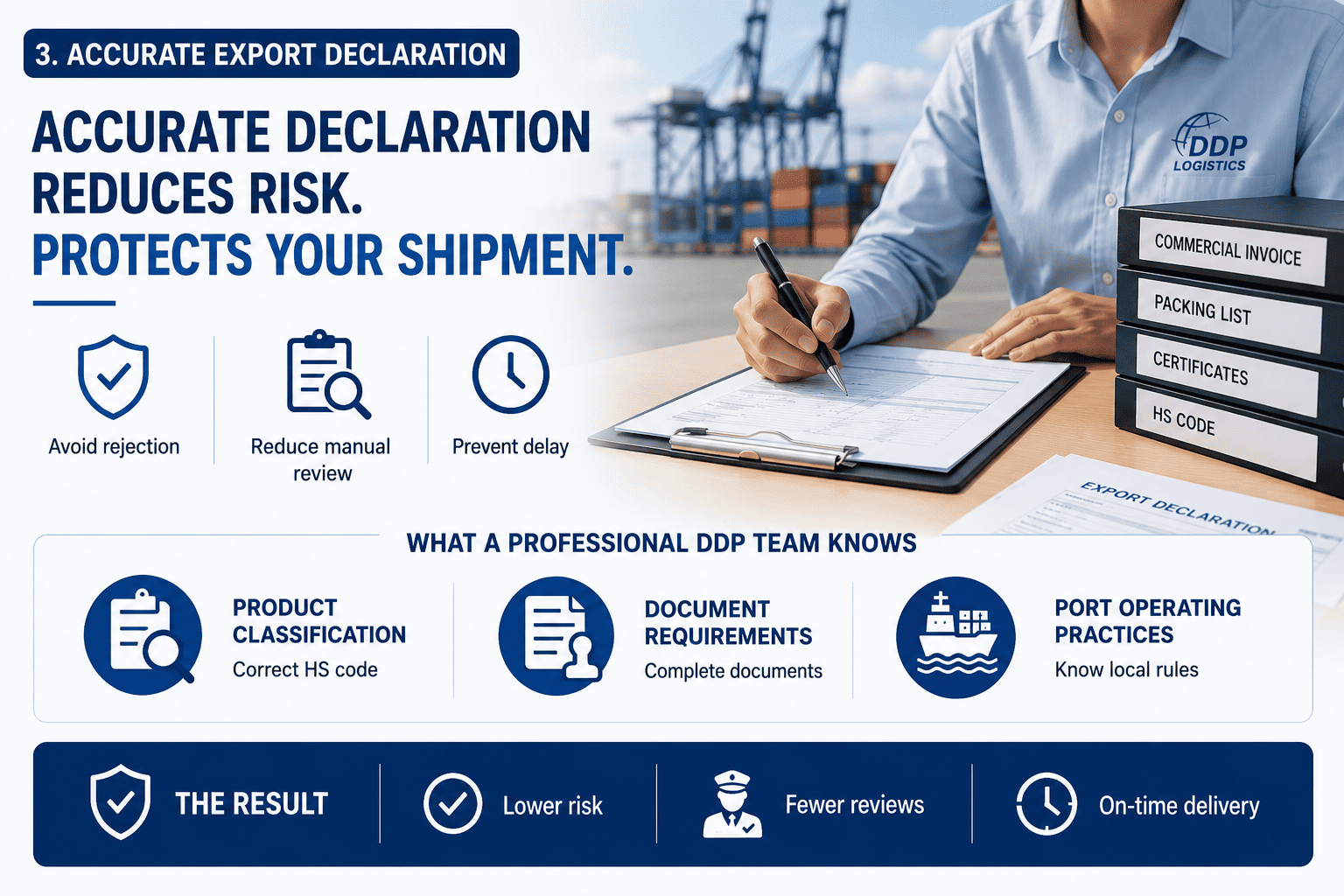
Customs Declaration Is Not Just Data Entry
I always tell customers that customs declaration is a professional part of logistics.
The product name matters.
The material matters.
The use matters.
The structure matters.
The HS code matters.
The supporting documents matter.
A small difference in the product can sometimes lead to a different classification.
For example, I once dealt with metal framework products where the structure of the product changed how the customs declaration team evaluated the cargo.
A product with holes, fittings, or clear finished-product characteristics may be treated differently from a simple solid metal profile.
For a normal buyer, both may be described as “metal frame.”
For customs declaration, that description may be too general.
This is why experienced customs teams do not only ask:
“What is the product name?”
They also ask:
“What is it made of?”
“How is it used?”
“Is it a finished product?”
“Does it have holes or fittings?”
“Is it processed material or raw material?”
“Do you have photos and specifications?”
Port Experience Also Matters
Another lesson I have learned is that port experience matters.
Our main export operations rely heavily on Guangzhou Nansha Port and Ningbo Port.
We use these ports because we are familiar with their operational processes and because stable routes and cargo flows can make planning easier.
A team that works with the same ports repeatedly can build practical experience.
It knows which documents should be prepared early.
It knows which product descriptions are too vague.
It knows what kinds of cargo require extra attention.
It can also react faster when customs requirements change.
| Weak Declaration Practice | Better Declaration Practice |
|---|---|
| Uses very general product names | Uses clear commercial descriptions |
| Chooses HS code only by product name | Checks material, structure, and use |
| Waits for customs questions | Reviews risk before submission |
| Uses the same method for every port | Understands regular port operations |
| Takes chances with unclear cargo | Requests supporting documents |
I do not believe in hiding product information to make customs clearance easier.
That strategy may save time once.
But it creates a much larger risk later.
If customs asks questions, the company needs to explain why the declared information does not match the real cargo.
That is not a situation I want for my customers.
A reliable DDP line should make the shipment easier by making the declaration more accurate, not by making the declaration less truthful.
Why Does Vessel Space Cause Major DDP Delays During Peak Season?
Many people think that once they receive a booking confirmation, the container is guaranteed to leave on time. Peak season can prove otherwise.
Vessel space becomes a major risk during peak seasons, holidays, and sales campaigns. If a freight forwarder has weak space allocation, a container may miss the planned sailing and wait for the next vessel, adding several days or more to the total DDP transit time.
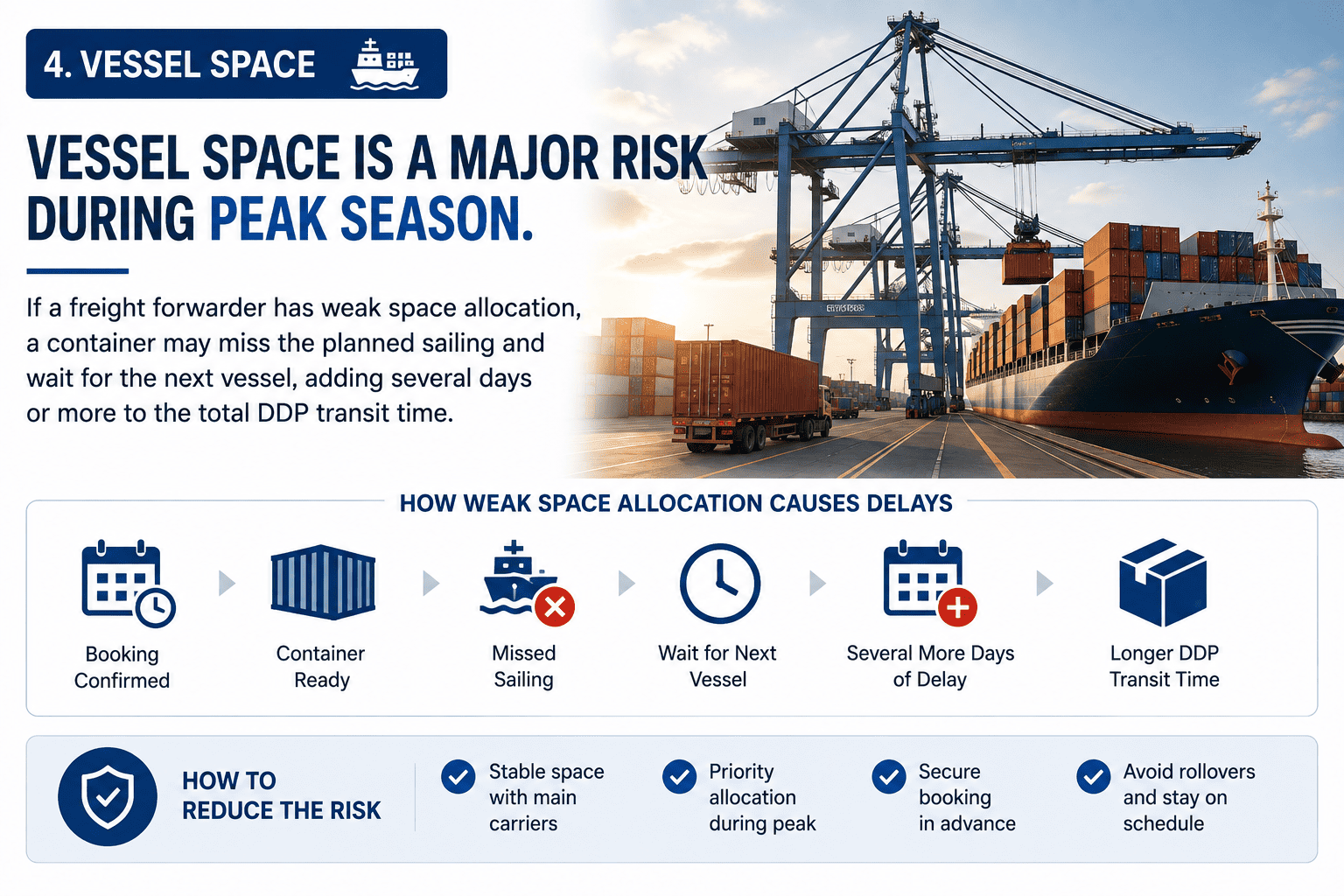
A Fast Sailing Schedule Means Nothing If the Container Cannot Get On the Vessel
This is one of the biggest differences between an attractive quotation and a stable shipping service.
A forwarder may show a very fast sailing schedule.
The vessel may have a good transit time.
The price may also look competitive.
But I always want to know one more thing:
Can the forwarder actually secure the space?
During normal periods, this question may not look important.
During peak season, it becomes critical.
Before major holidays, e-commerce sales campaigns, and factory shutdown periods, a large amount of cargo enters the market at the same time.
Vessel space becomes tight.
Shipping lines have to decide which containers can move on the planned sailing.
If the freight forwarder has weak space support, the container may be pushed to a later sailing.
Once that happens, the delay is not one day.
The shipment may need to wait for the next available vessel.
Depending on the route and schedule, this can add many days to the delivery time.
I Care More About Space Stability Than the Shortest Advertised Transit Time
When I evaluate a sea freight route, I look at several things.
| Factor | Why It Matters |
|---|---|
| Sailing frequency | More sailings give more backup options |
| Carrier relationship | Better cooperation can improve space stability |
| Contracted space | Helps during peak demand |
| Route consistency | Reduces unexpected changes |
| Port choice | Affects schedule and cargo handling |
| Backup plan | Important when one sailing is disrupted |
For Southeast Asia routes, I prefer to work with stable carrier resources instead of changing the carrier every week for a slightly lower price.
A small saving is not always worth the operational risk.
For an e-commerce seller, missing inventory arrival before a campaign can be very expensive.
For a machinery trader, missing a trade fair can mean losing customer opportunities.
For a factory, delayed delivery can affect the buyer relationship.
This is why I think shipping cost should always be compared with the cost of delay.
Stable Space Is a Supply Chain Resource
Many customers see a freight forwarder as a company that buys freight space.
I see it differently.
A good freight forwarder manages supply chain resources.
Warehouse capacity is a resource.
Customs knowledge is a resource.
Truck capacity is a resource.
Vessel space is also a resource.
When I work with regular routes from Nansha and Ningbo to Southeast Asia, I care about long-term stability.
I want predictable loading arrangements.
I want reliable sailing options.
I want a route that still works when the market becomes busy.
That is much more valuable than a route that looks great only during quiet periods.
Why Is Destination Customs Clearance the Most Important Part of DDP Shipping?
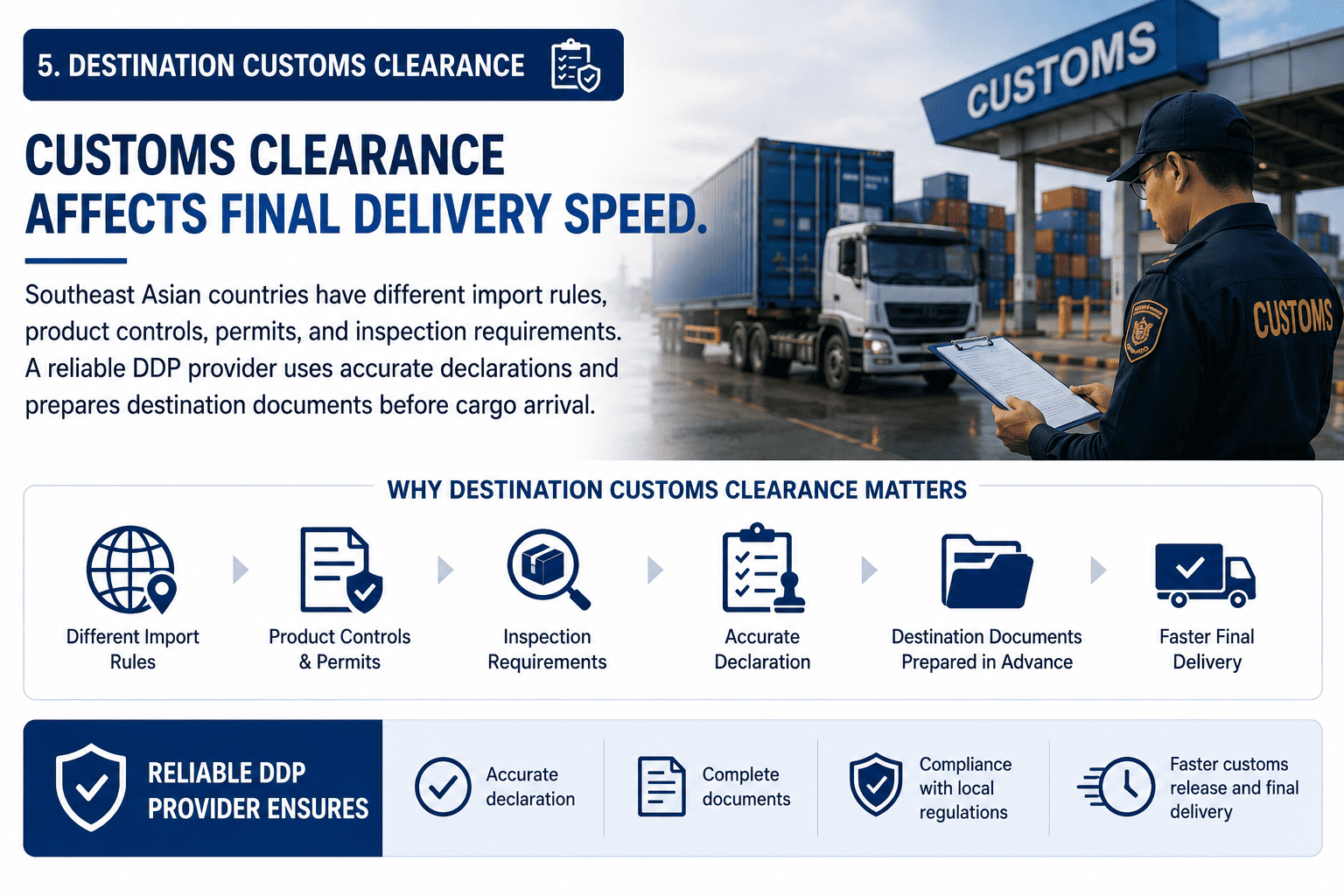
DDP means the customer expects the shipment to reach the final destination with customs and delivery already arranged. This makes destination clearance one of the most important parts of the service.
Destination customs clearance affects the final delivery speed because Southeast Asian countries have different import rules, product controls, permits, and inspection requirements. A reliable DDP provider uses accurate declarations and prepares destination documents before cargo arrival.
Every Southeast Asian Market Has Its Own Import Logic
One mistake I often see is treating Southeast Asia as one market.
It is not.
The Philippines, Indonesia, Vietnam, and Malaysia have different customs procedures, product controls, documentation requirements, and local import practices.
A product that clears smoothly in one country may need additional documents in another country.
This is why destination customs knowledge is very important.
In the Philippines, for example, certain food products, wood products, agricultural goods, regulated equipment, and other controlled products can require more attention.
Indonesia can also have stronger controls for selected consumer goods and protected product categories.
Products with batteries, magnets, liquids, chemicals, or special materials may require additional checks depending on the shipment and destination.
I do not think a freight forwarder should memorize one rule and use it for every customer.
The team should review the real product before shipping.
Why I Strongly Avoid False Declaration
Some low-quality channels try to make difficult cargo easier by changing the declared product name.
I think this is one of the most dangerous shortcuts in DDP shipping.
For example, imagine a product requires specific import documents.
Instead of preparing those documents, someone changes the declaration to another product category.
If customs does not inspect the shipment, the cargo may move.
That makes the method look successful.
But if the shipment is inspected, the problem becomes much bigger.
Possible consequences may include:
- Longer customs review
- Additional supporting-document requests
- Storage or port charges
- Reassessment of duties and taxes
- Penalties
- Cargo seizure in serious cases
- Legal or commercial disputes
I do not want to build a logistics service around luck.
I prefer compliance.
Good Customs Clearance Starts Before the Vessel Arrives
Our team works with customers before loading.
I ask for the product name.
I ask for photos.
I ask for the material.
I ask for the function.
I ask for the commercial value.
I also check whether the destination side needs additional supporting information.
This gives the clearance team more time.
| Clearance Stage | What I Prefer to Do |
|---|---|
| Before quotation | Understand the actual product |
| Before loading | Check documents and restrictions |
| Before vessel departure | Confirm shipment information |
| Before arrival | Prepare destination clearance |
| After arrival | Monitor customs and terminal status |
| After release | Arrange delivery immediately |
For our Philippines DDP shipments, having a local customs clearance team in Manila gives us more control over the destination process.
When there is a customs question, I prefer direct communication instead of waiting through several layers of agents.
This does not mean customs inspections will never happen.
Random inspections are part of international trade.
But a compliant shipment gives the team a much stronger position when an inspection happens.
How Do Warehouse and Trucking Operations Affect Southeast Asia DDP Transit Time?
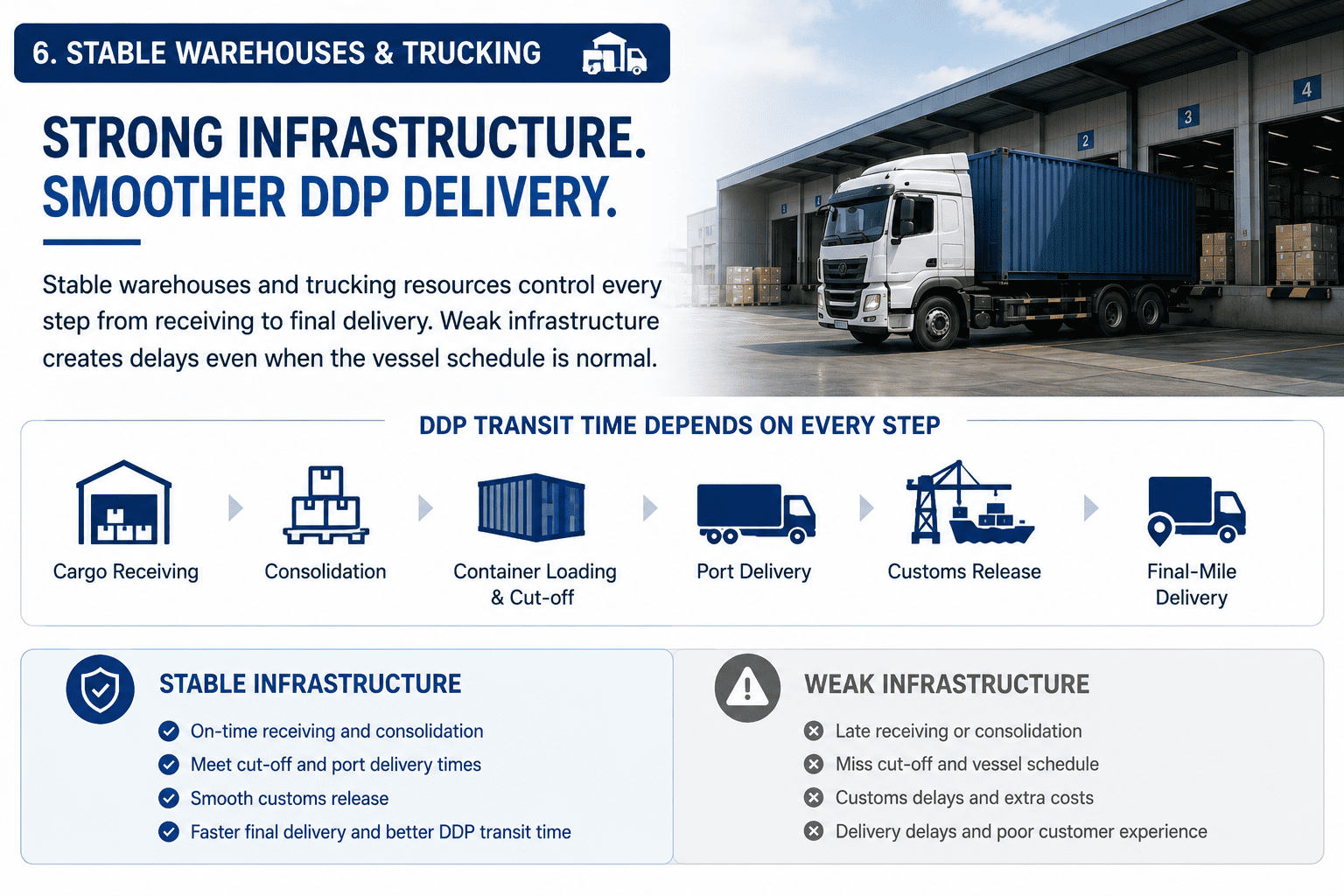
Customers often focus on vessels and customs. But warehouse and trucking problems can also make a shipment miss the planned sailing or delivery window.
Stable warehouses and trucking resources improve DDP transit time because they control cargo receiving, consolidation, container loading, cut-off times, port delivery, customs release, and final-mile delivery. Weak infrastructure creates delays even when the vessel schedule is normal.
A Reliable DDP Line Needs Strong Physical Operations
Logistics is not only information.
At some point, somebody needs to receive the cartons.
Somebody needs to count them.
Somebody needs to measure them.
Somebody needs to consolidate them.
Somebody needs to load the container.
Somebody needs to move the container to the port.
Somebody needs to pick it up at destination.
Somebody needs to deliver it to the customer.
If any of these physical operations are unstable, the whole shipment can be delayed.
I have seen small logistics companies depend heavily on temporary warehouses and temporary truck resources.
This can work when cargo volume is low.
But during peak periods, the weaknesses become obvious.
There may be no truck available.
Cargo may arrive too late for the cut-off.
Warehouse workers may not finish loading on time.
The container may miss the planned vessel.
At destination, the same problem can happen again.
Warehouse Stability Protects the Shipping Schedule
A stable warehouse should have clear receiving procedures.
It should know which cargo belongs to which shipment.
It should have fixed operating processes.
It should also have enough space to handle consolidation.
For DDP consolidation, this is especially important because cargo may arrive from many different Chinese suppliers.
One customer may buy packaging from Guangzhou.
Another product may come from Foshan.
Machines may come from Zhejiang.
Accessories may come from Shenzhen.
All these products may need to enter one shipping plan.
The warehouse becomes the control center.
| Warehouse or Truck Issue | Possible Result |
|---|---|
| Cargo received incorrectly | Missing or mixed shipments |
| Warehouse overloaded | Slow loading |
| Truck arrives late | Missed port cut-off |
| Container loading delayed | Missed vessel |
| Destination truck unavailable | Delivery delay |
| Delivery address unclear | Failed delivery attempt |
I See Warehouse, Customs, and Trucks as One System
For our China-to-Philippines business, I do not want customers to think that sea freight ends when the vessel arrives.
We have our own customs clearance team and local delivery fleet in Manila because destination control matters.
When the cargo is released, I want the delivery team to move quickly.
When the customer has a special unloading requirement, I want to know before the truck arrives.
When the shipment contains machines, I also want to understand the size and unloading conditions.
This is what DDP means to me.
It is not only paying duty and arranging transportation.
It is controlling the shipment from the Chinese supplier to the customer’s final location.
A reliable DDP line needs enough control at every stage.
That control creates the buffer that protects transit time when something unexpected happens.
Conclusion
Stable Southeast Asia DDP shipping does not come from luck. I build reliability through cargo screening, accurate customs work, stable vessel space, compliant clearance, and controlled warehouse and trucking operations.