
A low supplier price can become expensive after freight, taxes, missing parts, customs charges, and local delivery costs appear.
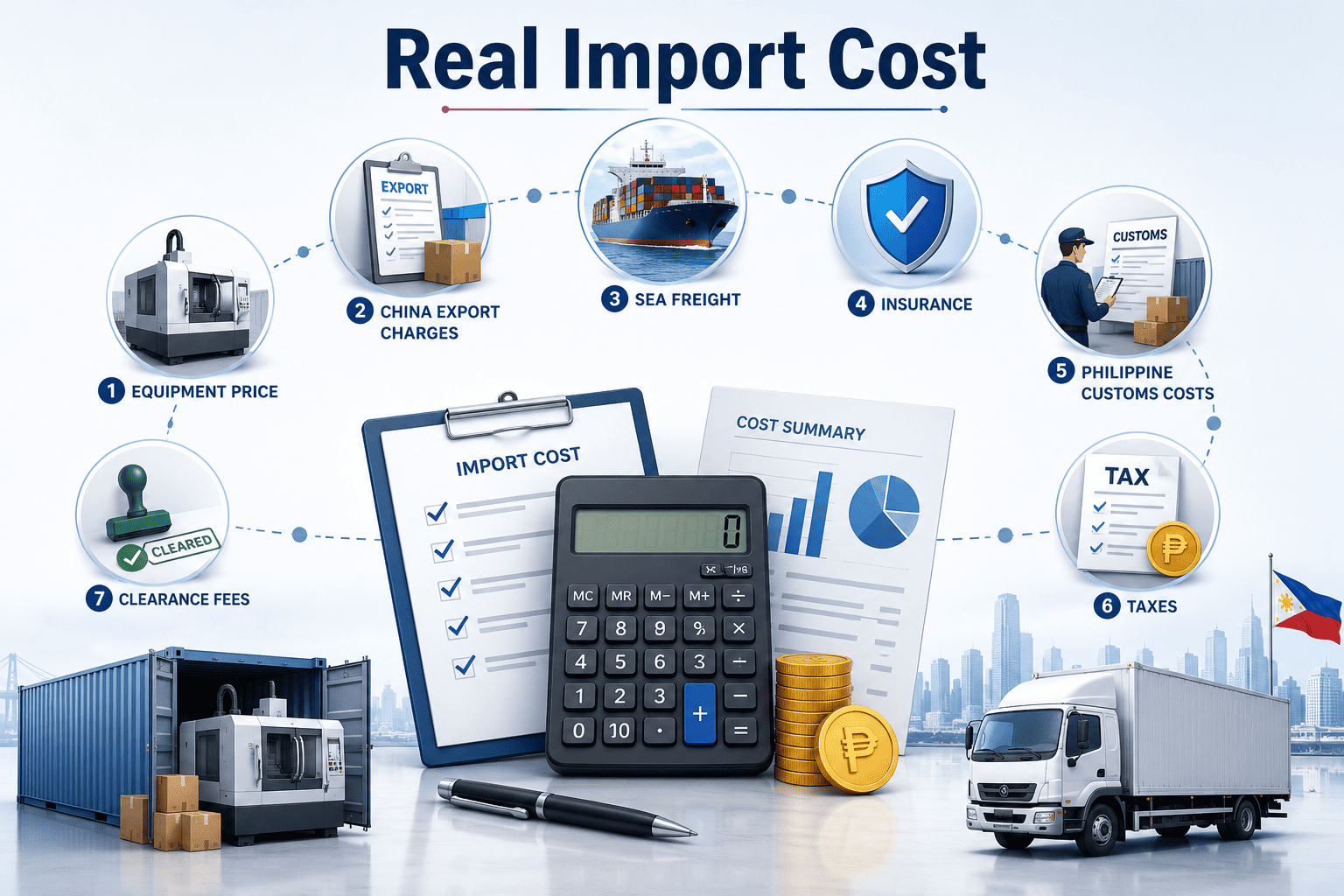
I calculate the real import cost by adding the equipment price, China export charges, sea freight, insurance, Philippine customs costs, taxes, clearance fees, and final delivery.
I have seen many commercial project owners focus only on the solar equipment price. I understand why. The supplier quotation is the first number they receive. It also looks like the easiest number to compare. However, the supplier price is only one part of the total investment.
When I help a buyer import a commercial solar power system from China to the Philippines, I first check the complete system scope. I then check the packing details, shipping method, customs requirements, taxes, destination charges, and final delivery location. This process helps me turn a basic supplier quotation into a more realistic landed-cost estimate.
What Should a Complete Commercial Solar System Quotation Include?
A quotation may look complete while excluding cables, protection devices, packaging, spare parts, freight, installation materials, or local delivery.
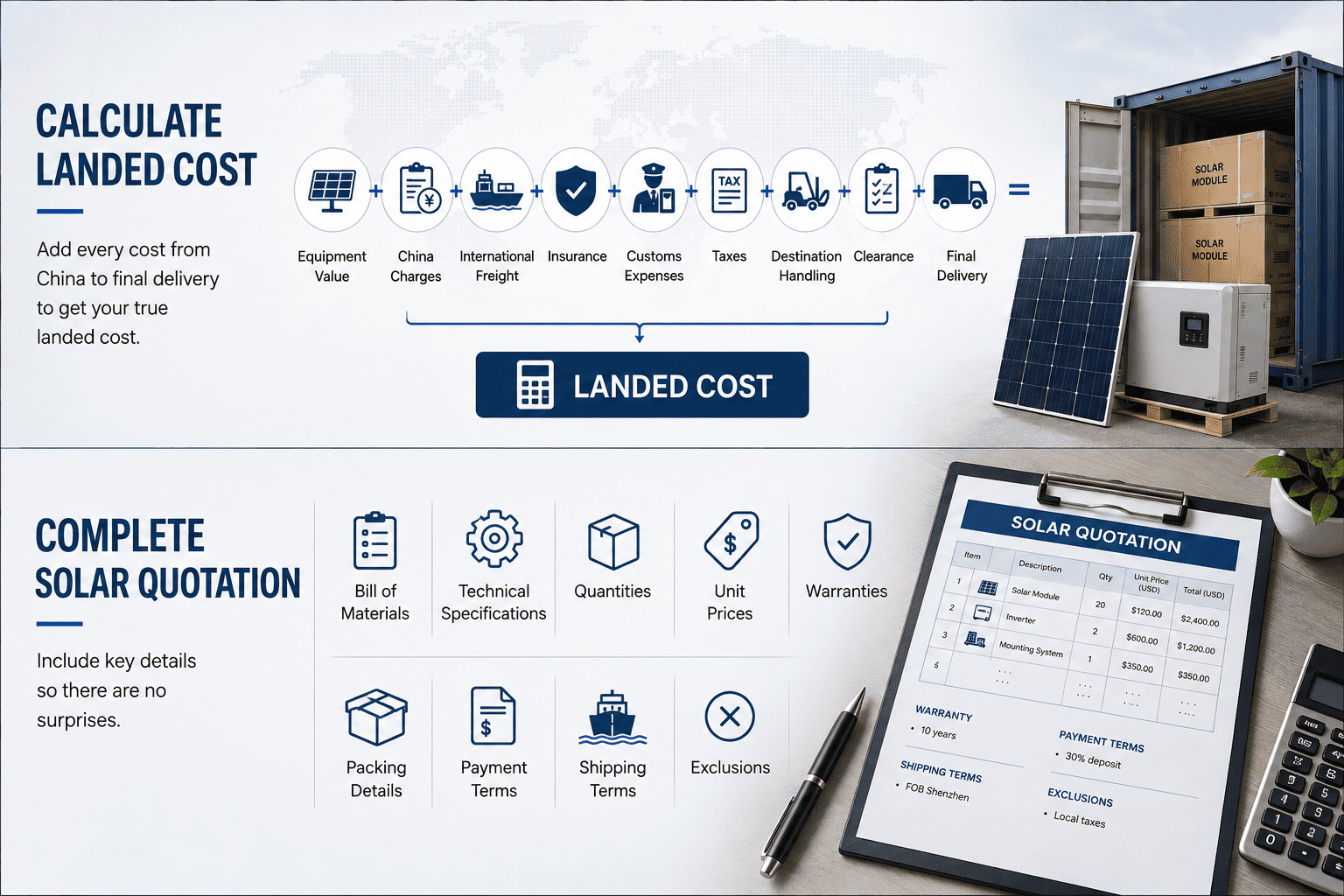
A complete solar quotation should include the full bill of materials, technical specifications, quantities, unit prices, warranties, packing details, payment terms, shipping terms, and exclusions.
I Start With the Exact System Design
I do not accept a quotation that only says “100 kW solar system.” That description is too general. Different suppliers can use the same system name while offering very different equipment.
I ask the supplier to confirm the total solar panel capacity, inverter capacity, operating voltage, number of phases, roof type, mounting method, cable length, and expected energy production. I also ask whether the system is grid-tied, hybrid, or off-grid.
A grid-tied system normally includes solar panels, inverters, mounting structures, DC cables, AC cables, connectors, protection devices, monitoring equipment, and electrical panels.
A hybrid system can also include lithium batteries, battery racks, battery cabinets, battery inverters, cooling systems, fire protection equipment, and battery management systems.
I ask the supplier to identify every major component by brand and model number.
| Quotation Item | Details I Request |
|---|---|
| Solar panels | Brand, model, wattage, quantity, efficiency, dimensions, and warranty |
| Inverters | Brand, model, AC output, voltage, phase, MPPT range, and warranty |
| Battery system | Battery chemistry, rated capacity, usable capacity, voltage, cycle life, and warranty |
| Mounting system | Roof type, material, wind-load design, fasteners, and quantity |
| DC equipment | Solar cables, connectors, combiner boxes, isolators, and surge protection |
| AC equipment | AC cables, breakers, panels, meters, transformers, and protection devices |
| Monitoring system | Data logger, communication equipment, software access, and sensors |
| Spare parts | Extra connectors, fuses, fans, boards, modules, and small accessories |
| Documents | Datasheets, manuals, drawings, test reports, and certificates |
I Check the Small Parts
I often find that the major products are included, but the small installation parts are missing. The buyer may receive the solar panels and inverters, but the project cannot start because the shipment does not include enough connectors, clamps, bolts, fuses, breakers, or cable terminals.
I ask the supplier to list quantities instead of using general descriptions. I want to know the cable length, connector quantity, breaker rating, rail length, clamp quantity, grounding material, and spare-part quantity.
Small parts usually have a low product value. However, they can create high costs when the buyer needs urgent air freight. A missing electrical component can also stop the entire installation team.
I also ask whether the quotation includes labels, cable trays, tools, monitoring devices, testing equipment, packaging, loading, and export documents.
I Check Warranty Support Before Payment
A long warranty does not always mean strong after-sales service. I ask who will inspect a failed product, who will approve the warranty claim, and who will pay for replacement shipping.
I also check whether the inverter or battery brand has technical support in the Philippines. Local technical support can reduce downtime. It can also help the installer solve communication, software, or configuration problems.
I request written warranty terms before I pay the deposit. I keep the serial-number list, factory test records, loading photos, commercial invoice, packing list, and shipping documents.
How Do I Calculate the Total Landed Cost in the Philippines?
The factory price does not show the complete project cost. The final amount can rise after freight, customs, taxes, port charges, and delivery.
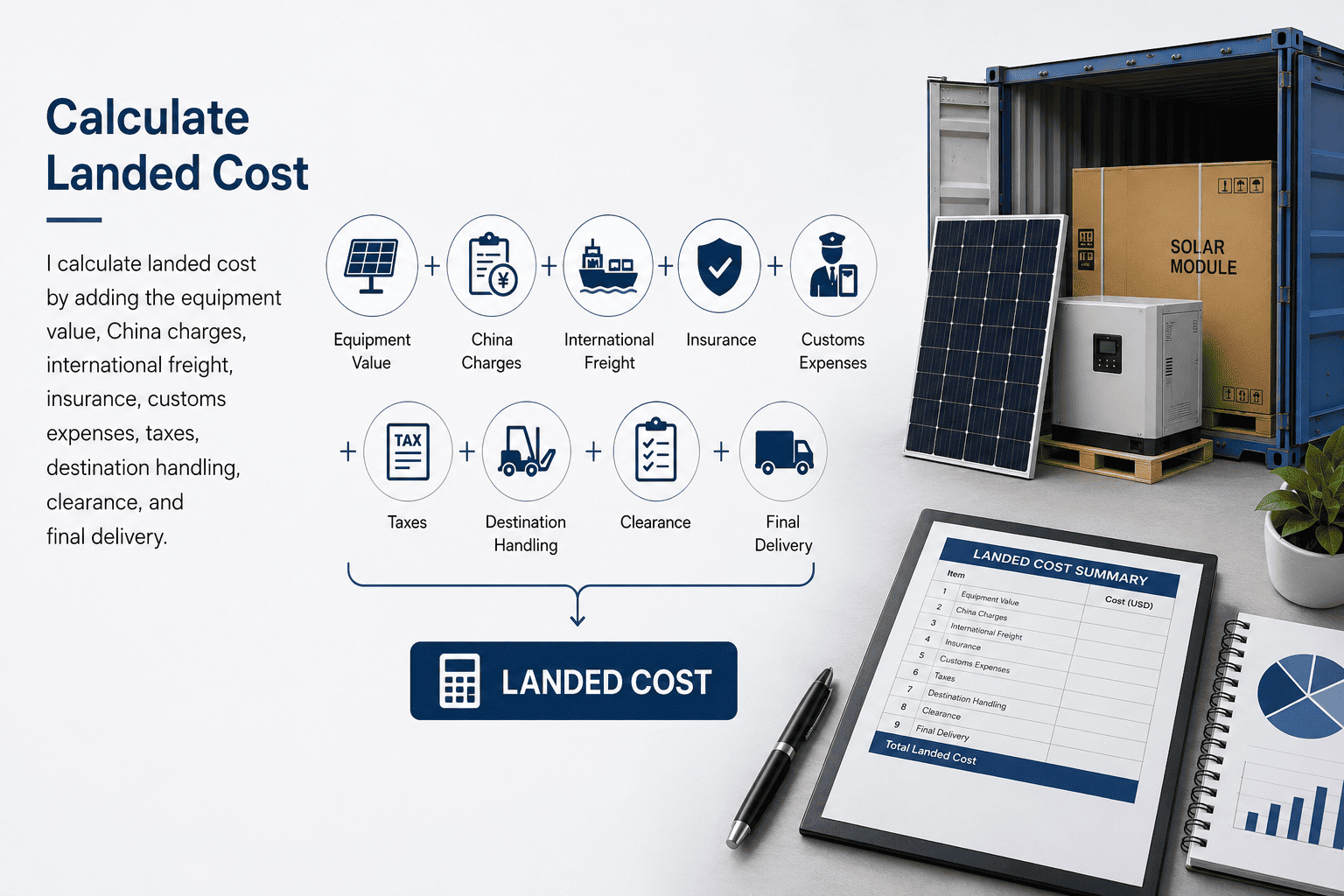
I calculate landed cost by adding the equipment value, China charges, international freight, insurance, customs expenses, taxes, destination handling, clearance, and final delivery.
I Use a Clear Landed-Cost Formula
I use the following basic formula:
Total Landed Cost = Equipment Cost + China Export Charges + Sea Freight + Insurance + Customs Charges + Taxes + Port Charges + Clearance Fees + Final Delivery
I calculate the landed equipment cost per watt after I find the total cost.
Landed Cost per Watt = Total Landed Cost ÷ Total DC System Wattage
For example, I divide the landed cost of a 100.1 kWp solar system by 100,100 watts.
I calculate battery storage separately. A battery system should not be compared only by its total price. I check the usable battery capacity.
Battery Landed Cost per kWh = Total Battery Landed Cost ÷ Usable Battery Capacity
This calculation helps me compare different battery brands, battery chemistries, cycle-life claims, and depth-of-discharge limits.
I Separate Each Cost Layer
| Cost Layer | Common Items |
|---|---|
| Equipment cost | Panels, inverters, batteries, structures, cables, and protection equipment |
| China export charges | Factory pickup, loading, export declaration, documents, and origin handling |
| International freight | LCL freight, FCL freight, dangerous-goods freight, and carrier charges |
| Cargo insurance | Protection against covered damage or cargo loss |
| Customs and taxes | Import clearance, duties, taxes, and related government charges |
| Destination charges | Port handling, documents, terminal fees, and container charges |
| Local clearance | Customs broker service and import document processing |
| Final delivery | Trucking, unloading arrangements, warehouse delivery, and site delivery |
| Risk reserve | Storage, inspection, demurrage, detention, and unexpected handling |
I do not place every solar product under one general description. Solar panels, inverters, mounting structures, cables, lithium batteries, transformers, and electrical protection devices have different product properties.
I prepare a detailed packing list before shipment. I make sure the commercial invoice shows clear product names, brands, models, quantities, and values.
I Build a Sample 100 kWp Cost Model
The following table is only an example. Actual prices depend on equipment brands, system design, battery requirements, shipment size, destination, exchange rates, and project conditions.
| Cost Item | Illustrative Amount |
|---|---|
| Solar panels | USD 18,200 |
| Commercial inverters | USD 7,500 |
| Mounting structures | USD 9,500 |
| Cables and protection equipment | USD 8,000 |
| Monitoring equipment and spare parts | USD 2,800 |
| Export packaging and inspection | USD 1,500 |
| Equipment subtotal | USD 47,500 |
| China pickup and export charges | USD 1,600 |
| International sea freight | USD 3,800 |
| Cargo insurance | USD 300 |
| Customs and tax reserve | USD 7,700 |
| Port, clearance, and documents | USD 2,400 |
| Delivery to a Metro Manila address | USD 1,600 |
| Estimated landed equipment cost | USD 64,900 |
The estimated landed equipment cost in this example is about USD 0.65 per DC watt.
This example does not include local installation labor, structural reinforcement, engineering design, utility applications, testing, permits, cranes, civil works, or site preparation.
I keep the imported equipment budget separate from the local project budget. This method helps me see which costs come from China and which costs come from the Philippine installation site.
How Does Our China-to-Philippines DDP Service Work?
Managing several agents can create unclear costs, delayed communication, customs problems, and disputes about who should handle the final delivery.
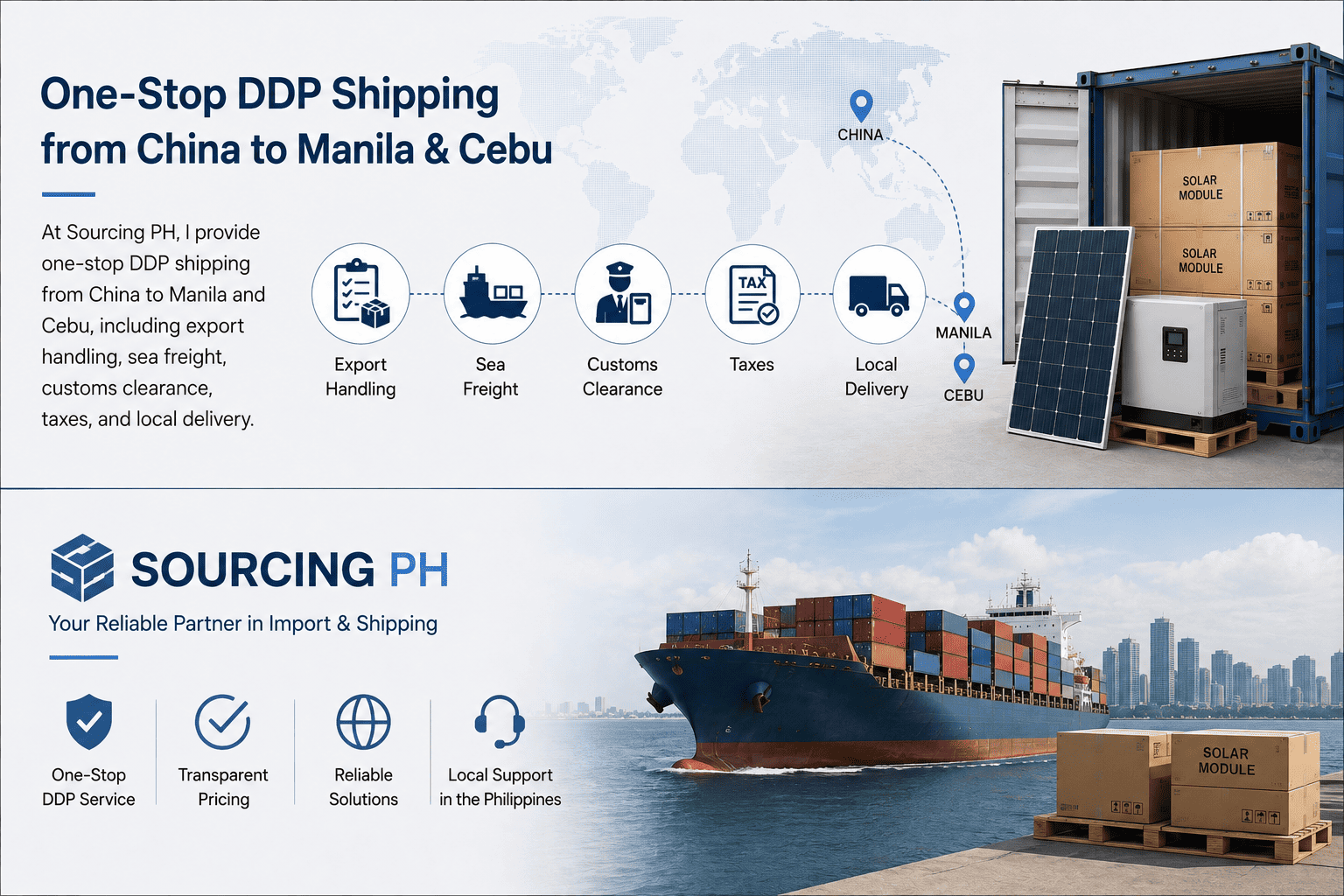
At Sourcing PH, I provide one-stop DDP shipping from China to Manila and Cebu, including export handling, sea freight, customs clearance, taxes, and local delivery.
I Provide LCL and FCL Shipping Options
I understand that commercial solar projects do not all have the same cargo volume. Some buyers import one inverter, several pallets of solar panels, or a small batch of mounting materials. Other buyers import complete systems in full containers.
For this reason, I provide two main shipment options.
| Shipment Type | Best For | Main Features |
|---|---|---|
| LCL shipment | Small orders and repeated shipments | The cargo shares container space with other shipments |
| FCL shipment | Large commercial projects | One full container can be loaded for one customer |
I use LCL shipping for small-volume or multi-batch orders. The customer does not need to wait until the cargo can fill a complete container.
I use FCL shipping for larger projects. I can arrange a truck to collect the empty container and move it to the supplier’s factory. The supplier can then load the goods directly into the container.
Direct factory loading can reduce extra cargo handling. It is especially useful for solar panels, because repeated warehouse handling can increase the risk of broken glass, damaged frames, wet packaging, or missing pallets.
Before I quote the shipment, I ask for the packing list. I check the carton quantity, pallet quantity, gross weight, net weight, cargo volume, and package dimensions.
I Include the Main DDP Cost Stages
My DDP service is designed as a one-stop, tax-inclusive, door-to-door solution. I explain the service scope before the shipment starts so the customer can understand what is included.
| Shipping Stage | Services Included |
|---|---|
| China export stage | Export declaration, customs handling, and China-side operating charges |
| International stage | Sea freight from China to the Philippines |
| Philippine destination stage | Customs clearance at Manila or Cebu and included import taxes and charges |
| Final delivery stage | Delivery to the customer’s specified address in Manila or Cebu |
The customer does not need to manage a China freight forwarder, an international carrier, a Philippine customs broker, and a local truck company separately.
At Sourcing PH, I coordinate the full transportation process. My team follows the shipment from the supplier’s factory to the final destination.
We have a customs-clearance team and delivery resources in the Philippines. We can also receive suitable solar cargo at our local warehouses in Manila or Cebu before arranging the final delivery.
I still explain all important conditions in the quotation. I state the delivery area, cargo type, shipment method, included services, and possible special requirements. This process helps both sides avoid misunderstandings.
I Treat Lithium Batteries as Dangerous Goods
Lithium batteries are different from solar panels and inverters. Energy-storage batteries have special transportation risks. They cannot always move through the same shipping channel as general cargo.
I classify lithium batteries, including commercial energy-storage batteries, as dangerous-goods cargo for shipping purposes when the transport rules require this treatment.
The shipment may require a dangerous-goods container, approved packaging, battery labels, test documents, cargo declarations, and carrier approval. The freight rate is usually higher than the rate for ordinary solar equipment.
I do not recommend hiding lithium batteries inside a general cargo shipment. An incorrect cargo declaration can cause booking rejection, customs delays, penalties, cargo holds, or serious safety risks.
I use a compliant dangerous-goods process for export declaration, sea transportation, Philippine customs clearance, and final delivery.
Before quoting battery freight, I normally request the following information:
| Required Information | Why I Need It |
|---|---|
| Battery type | It helps identify the cargo category |
| Battery chemistry | Lithium-ion, lithium iron phosphate, and other types may need different documents |
| Model and capacity | It helps confirm technical details |
| Number of batteries | It affects total weight and cargo planning |
| Gross weight | It affects freight and container limits |
| Package dimensions | It affects container space |
| Safety documents | The carrier may request transport and testing records |
| Packing method | It helps confirm whether the packaging meets transport requirements |
A battery quotation may take more preparation than a normal solar panel quotation. However, a proper quotation reduces the risk of unexpected rejection after the cargo is ready.
I Ship Solar Panels and Inverters as General Cargo
Solar panels and inverters are normally easier to ship than lithium batteries. They can usually move as general cargo through standard container channels when no special product condition changes the classification.
I can arrange normal export declaration, sea freight, customs clearance, warehousing, and local delivery for these products.
Solar panels still need careful packing. I check the pallet condition, corner protection, waterproof wrapping, product labels, and loading plan.
Inverters also need protection against moisture, impact, and incorrect stacking. I ask the supplier to use strong export cartons or wooden cases when the product size and value require extra protection.
For suitable solar-panel and inverter shipments, I can work with stable shipping channels and competitive freight arrangements. I also coordinate the customs documents before cargo departure.
When legally available and suitable for the shipment, my team can review applicable customs or tariff arrangements. I do not promise a special customs result before checking the product documents and shipment details.
My goal is to keep the shipment compliant, stable, and clear from the supplier’s factory to our Manila or Cebu warehouse or the customer’s delivery address.
What Information Do I Need to Prepare an Accurate DDP Quotation?
A freight estimate can become inaccurate when the buyer only provides the product name and purchase value.
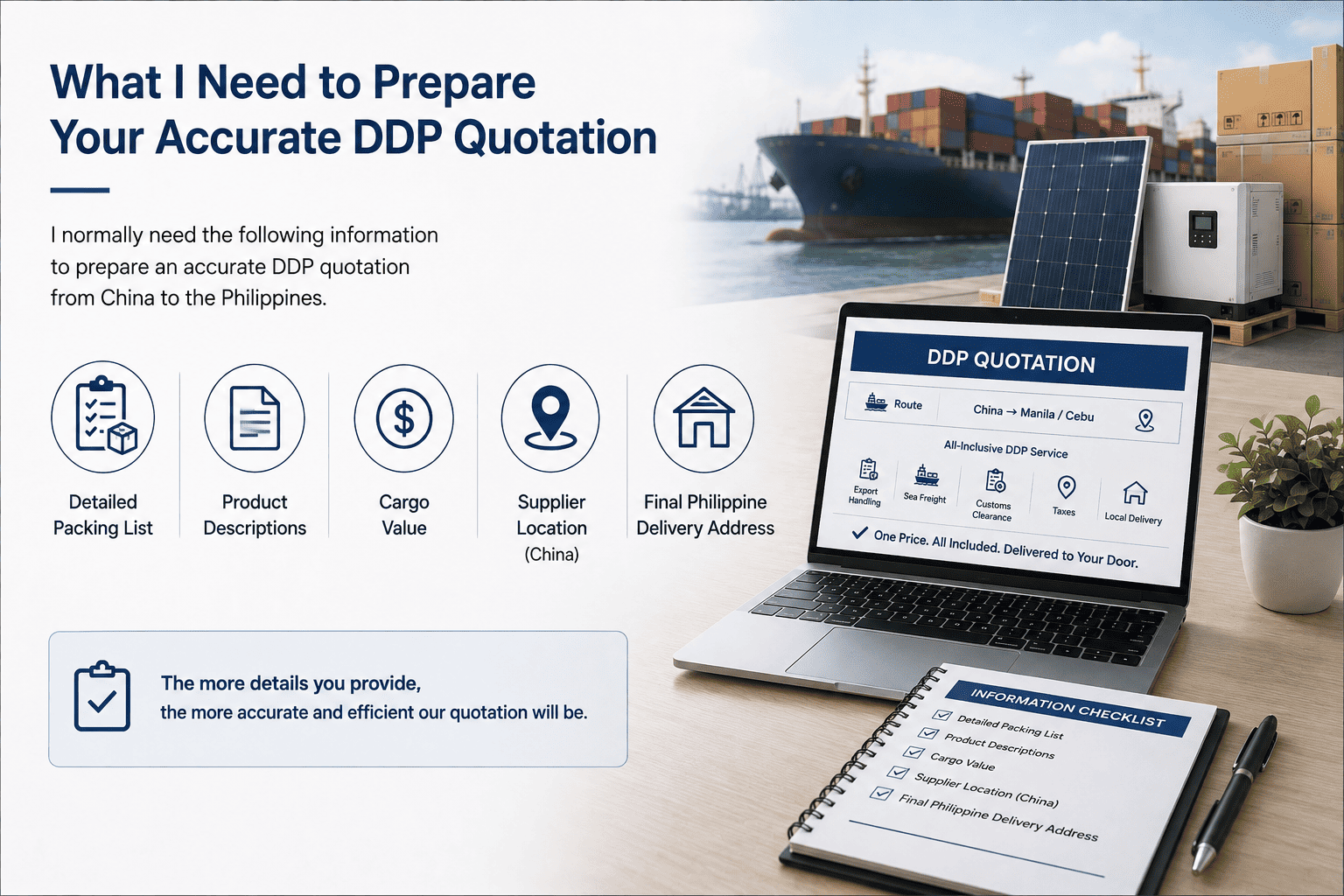
I normally need a detailed packing list, product descriptions, cargo value, supplier location, and final Philippine delivery address to prepare an accurate DDP quotation.
I Start With the Packing List
The packing list is one of the most important documents for a shipping quotation. I cannot calculate freight correctly without the cargo weight, volume, quantity, and package dimensions.
A good packing list should include:
| Packing Detail | Example |
|---|---|
| Product name | Monocrystalline solar panel |
| Model | ABC-580W |
| Quantity | 180 pieces |
| Carton or pallet quantity | 6 pallets |
| Gross weight | 6,500 kg |
| Net weight | 6,100 kg |
| Package dimensions | 2.3 × 1.2 × 1.2 metres per pallet |
| Total volume | 19.8 cubic metres |
| Cargo value | USD 18,000 |
| Supplier address | Foshan, Guangdong, China |
| Delivery address | Quezon City, Metro Manila |
For battery cargo, I also request the battery chemistry, watt-hour rating, battery weight, packaging method, and available safety documents.
I review the packing information before I recommend LCL or FCL shipping. Sometimes, the cargo volume is close to a full-container level. In that case, FCL may provide better control and lower handling risk.
I Confirm the Delivery Area
A Manila quotation is not automatically the same as a Cebu quotation. Port routing, sea freight, destination handling, and final trucking costs can be different.
I ask for the exact city, district, or delivery address before I issue the final quotation.
My standard door-to-door service can cover deliveries to customer addresses in Manila and Cebu service areas. For locations outside the main city areas, I check the additional trucking distance, road conditions, unloading needs, and site access.
I also ask whether the customer has a forklift, unloading team, loading dock, or crane. A heavy commercial inverter or battery cabinet cannot always be unloaded by hand.
I Provide a Clear Quotation and Shipping Plan
After I receive the packing list, I prepare a quotation based on the cargo type and shipment method.
The quotation can show:
| Quotation Detail | What I Explain |
|---|---|
| Shipping method | LCL, general FCL, or dangerous-goods FCL |
| Port route | China to Manila or China to Cebu |
| Service type | DDP door-to-door delivery |
| Included charges | Export, freight, clearance, taxes, and delivery |
| Cargo requirements | Documents, labels, packaging, and declarations |
| Estimated transit schedule | Expected shipping and handling stages |
| Delivery scope | Warehouse or customer address |
| Important exclusions | Special unloading, remote delivery, or unexpected inspections when applicable |
I provide one-to-one shipment follow-up. I coordinate with the supplier, China operations team, shipping line, Philippine customs team, warehouse, and delivery team.
The buyer does not need to contact each party separately. This arrangement is especially useful for commercial project owners who are importing solar products for the first time.
How Can I Avoid Hidden Charges and Quotation Mistakes?
A quotation can look complete while excluding destination handling, unloading, storage, dangerous-goods charges, warranty freight, or local installation work.
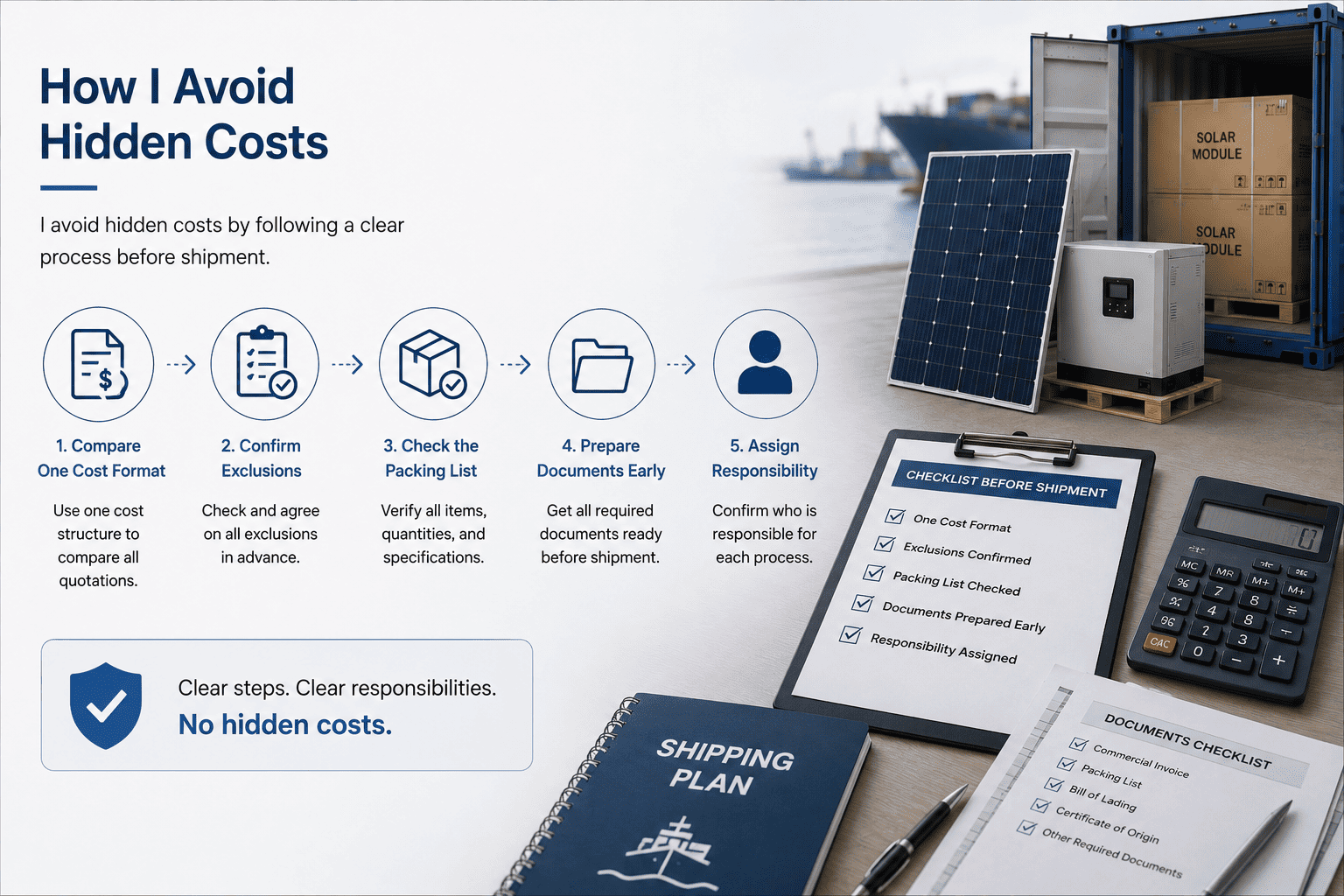
I avoid hidden costs by comparing one cost format, confirming exclusions, checking the packing list, preparing documents early, and assigning responsibility before shipment.
I Compare Suppliers With the Same Table
I do not compare only the final quotation totals. I place each supplier’s quotation into one standard table.
| Comparison Point | Supplier A | Supplier B | Supplier C |
|---|---|---|---|
| Solar panel capacity | |||
| Inverter output | |||
| Battery usable capacity | |||
| Panel brand and model | |||
| Inverter brand and model | |||
| Mounting material | |||
| Protection equipment | |||
| Monitoring system | |||
| Spare parts | |||
| Warranty support | |||
| Shipping term | |||
| Packed volume and weight | |||
| Estimated landed cost | |||
| Landed cost per watt |
I check whether all suppliers use the same system capacity, inverter ratio, voltage, phase, roof type, cable length, mounting design, and battery scope.
A low quotation may simply include fewer products.
I Confirm Possible Extra Costs
Even with a DDP service, I explain special conditions that can create extra work or extra costs.
| Possible Cost | Why It Can Appear |
|---|---|
| Storage | Documents are incomplete or delivery is delayed |
| Demurrage | A container stays at the terminal beyond the free period |
| Detention | An empty container is returned late |
| Inspection | Customs or another authority requests cargo examination |
| Special unloading | The cargo needs a forklift, crane, or extra workers |
| Remote delivery | The project site is outside the standard service area |
| Dangerous-goods handling | Lithium batteries require special transport procedures |
| Packaging correction | The original export packaging is not suitable |
| Warranty freight | Defective equipment must be returned or replaced |
| Urgent spare parts | Replacement parts need air freight |
| Site modification | The mounting system does not match the actual roof |
| Local installation | The equipment quotation does not include Philippine labor |
I state the normal service scope in writing. I also state any special condition before booking the shipment.
I Inspect the Cargo Before Shipment
I arrange or recommend pre-shipment inspection for large commercial orders.
I check the product model, quantity, serial numbers, packaging, accessories, labels, and visible damage. I also compare the finished products with the approved bill of materials.
For solar panels, I check the pallet condition, frame condition, glass surface, labels, and packing strength.
For inverters, I check the model, voltage, phase, communication accessories, and carton condition.
For batteries, I check the battery labels, package markings, quantity, technical documents, and declared shipment information.
I request loading photos and container-loading records. I also record the container number and seal number.
These records help me investigate shortages, loading mistakes, and transportation damage.
Conclusion
I reduce solar import risk by checking the full quotation, separating battery cargo, calculating landed cost, and using one DDP partner from China to the Philippines.